

Electric Engraver for Tools

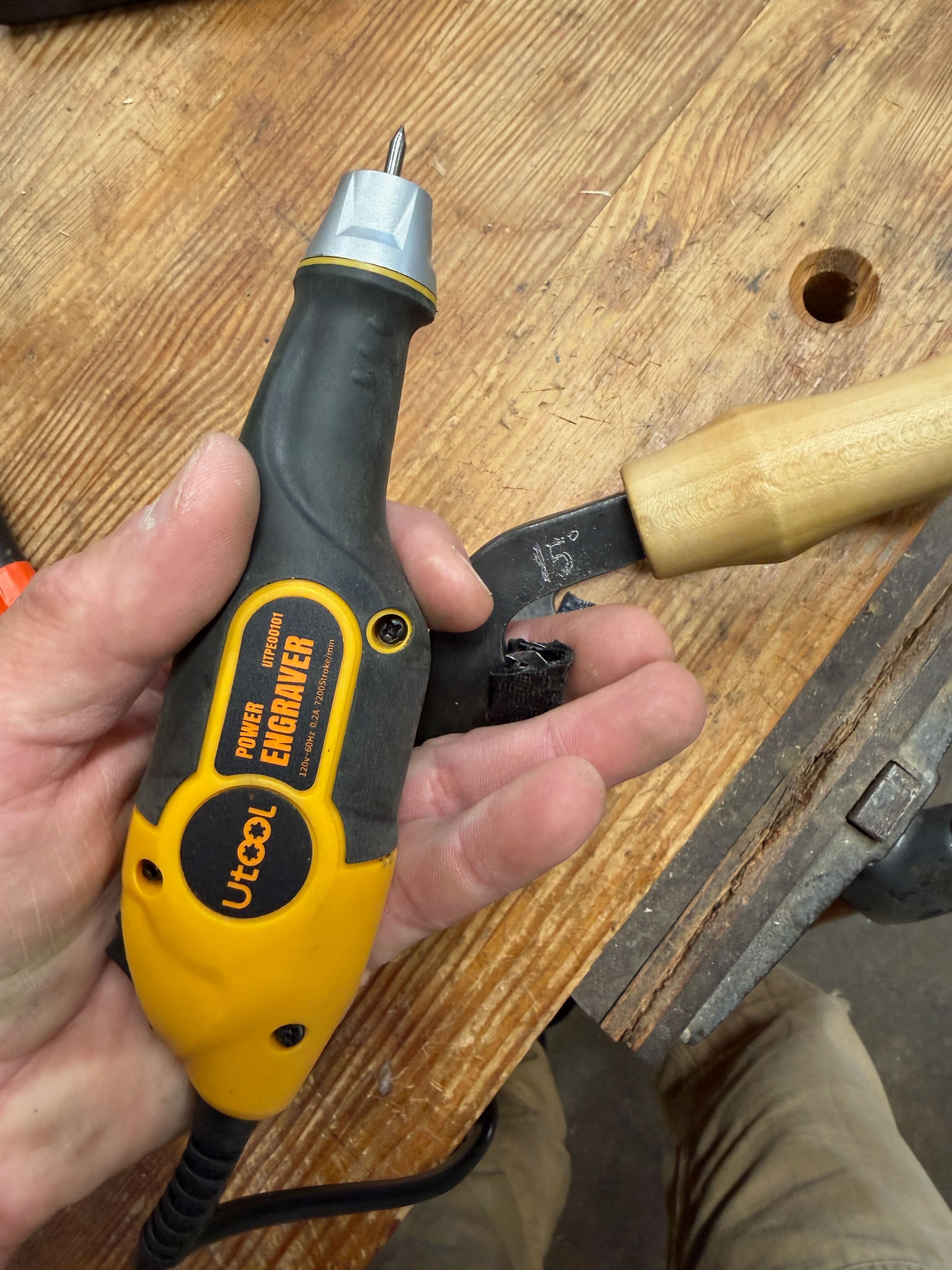
The written word is nice. But the engraved word lasts longer.
There are many times that I need to save important information about a tool. And writing it down, even in “permanent” marker, just isn’t enough.
So years ago I sprung for this inexpensive engraver, and I’m surprised how much I use it to record things such as sharpening angles or the exact composition of a piece of tool steel (A2, O1, M2 etc.).
Sometimes I engrave important information for my future self, such as “do not power grind” on tools that are laminated steel. Other times I engrave who the tool belongs to or where it came from. When I used to build a lot of campaign furniture, I would engrave the hardware to record its position on the piece – that made it easier to reassemble the piece after finishing.
But mostly, I engrave bevel angles and steel composition. All of our inshaves are ground at different angles and need to be polished at that angle. So engraving it on the metal shaft between the blade and handle makes my sharpening chores easier.
And most manufacturers don’t record what sort of steel is in the chisel or plane blade (some do, and thank you for that). So when I get my mortise chisels out, the engraved “M2” is a reminder that I’m going to need to use a diamond stone to turn a burr on the tip.1
I wouldn’t say the electric engraver is an “essential” piece of woodworking gear. But it does make my life in the shop a little less frustrating. And for $25 (give or take, depending on the brand), I’m happy to have it around.
P.S. This is a lightweight review – I know. Look for something upsetting later this week.
Editor’s note: And for those of who have astigmatism beyond the redemptive capacity of corrective lenses, it comes in handy for marking “X-cut” and “rip” on the plates or spines of backsaws; those teeth are soooo hard to see!
Your Editor's Note is exactly what I thought about. Why, oh why, can't they mark saw spines better? Well, if you watch the Smarter Every Day about making a grill scrubber in America (highly recommend it: https://share.google/cZjVo76yaNUqyWXHH ), you'll understand a bit of the cost involved. Still...
Yeah, it's surprising how much logistical and support effort goes into making things. Lately I've been watching a variety of construction project videos and I am seeing a lot of preparatory work documented.
I haven't counted the "support" versus "build" time or effort, but (for example) the seven-year rebuild of Tally Ho documented in over 200 videos includes a vast amount of prep work.
Candidly, I find prep work soothing. At the end of the day I always leave time to put everything away and clean up my shop. And I am always glad when I come back to find a clean shop ready for me to get to work rather than a mess that requires that I put off the fun stuff while I clean and tidy.
And, as I think I mentioned in another comment, time spent putting things back where they came from is subtracted from the time required to find them next time I need them.
Good on you for putting a light on this stuff.